Milky Way
Where do we live?
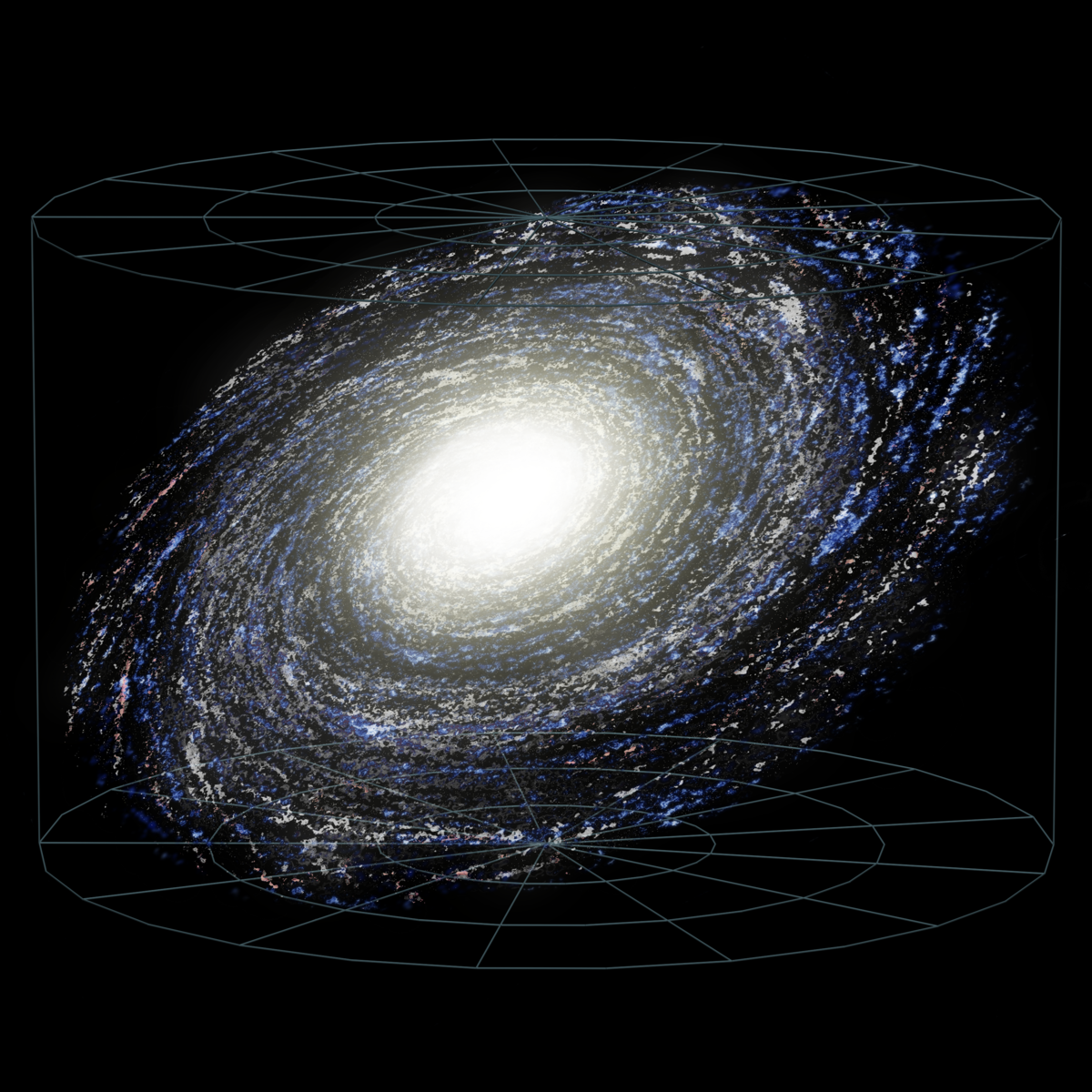
Earth is located in one of the spiral arms of the Milky Way (the Orion Arm), about two-thirds of the way out from the center of the galaxy. Here we are part of the Solar System — a group of eight planets, plus numerous comets, asteroids, and dwarf planets that orbit the Sun. The Solar System formed about 4.6 billion years ago from the gravitational collapse of a giant interstellar molecular cloud. The vast majority of the system's mass is in the Sun, with most of the remaining mass contained in Jupiter.
Our galactic neighborhood
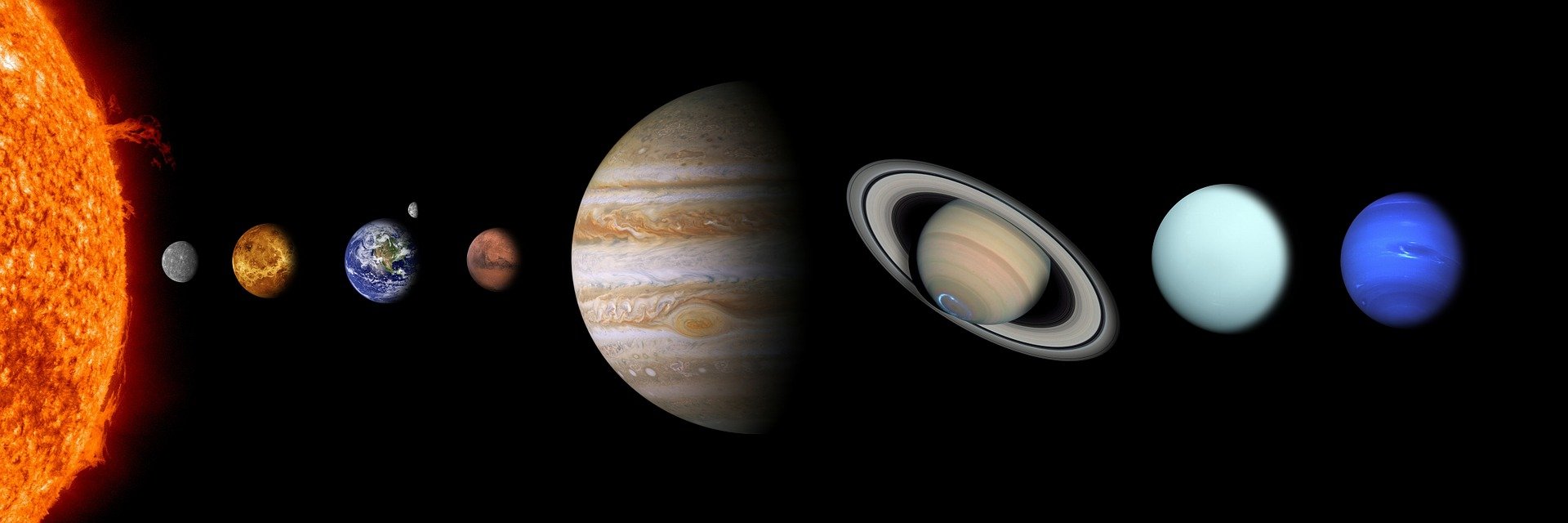
The four inner system planets—Mercury, Venus, Earth and Mars—are terrestrial planets, being composed primarily of rock and metal. The four giant planets of the outer system are substantially larger and more massive than the terrestrials. The two largest, Jupiter and Saturn, are gas giants, being composed mainly of hydrogen and helium; the next two, Uranus and Neptune, are ice giants, being composed mostly of volatile substances with relatively high melting points compared with hydrogen and helium, such as water, ammonia and methane. All eight planets have nearly circular orbits that lie close to the plane of the Earth's orbit, called the ecliptic.
Stars
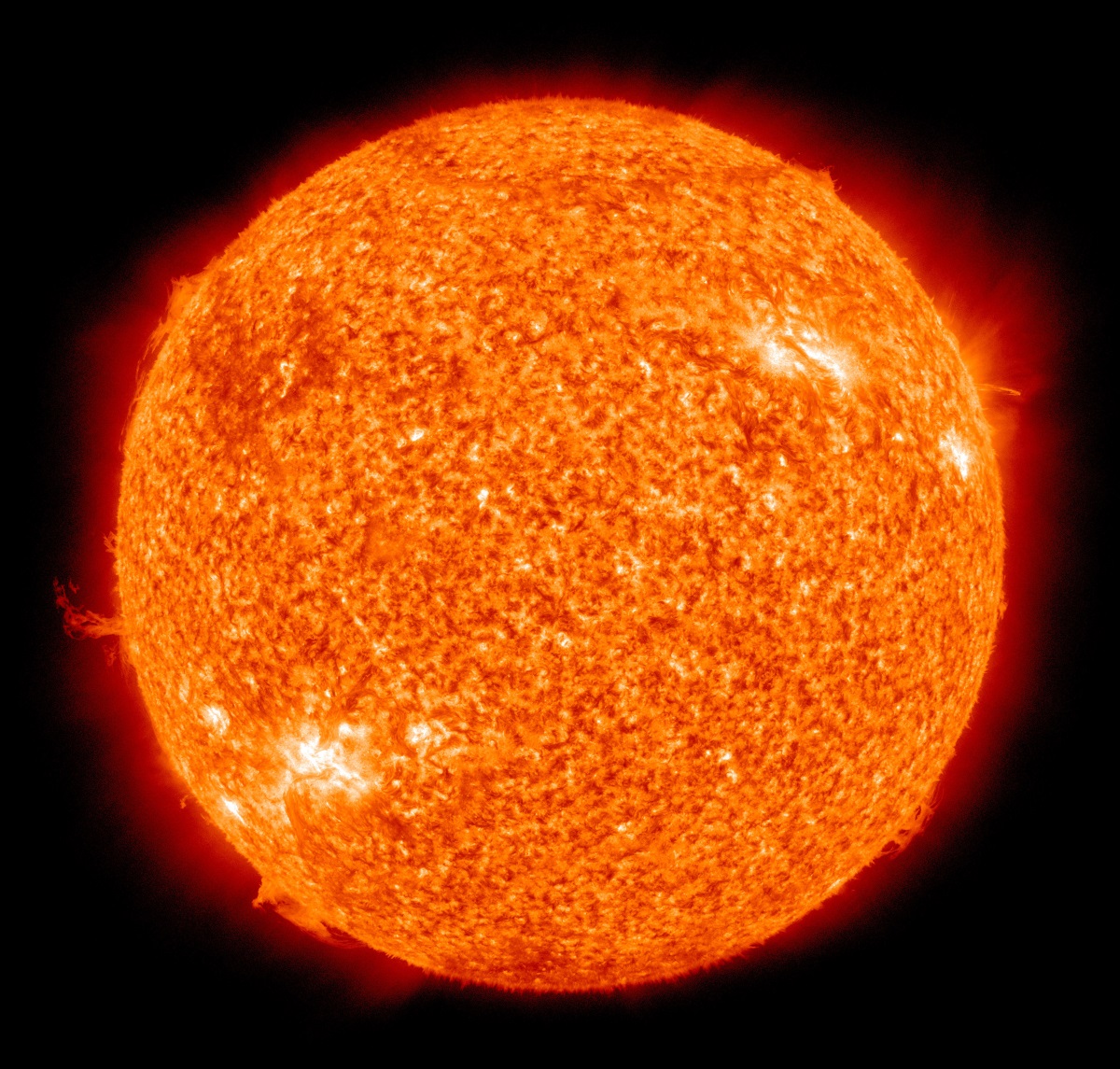
Age: At least 4.5 billion years old.
Diameter: 1.39 × 10^6 km (109 times the diameter of the Earth and 9.75 times the diameter of Jupiter).
Volume: 1.41 × 10^33 cm^3 (about 1.3 million times the volume of the Earth).
Mass: 1.99 × 10^30 kg (about 333,000 times the weight of the Earth).
Moons
Our solar system has many known moons, and new ones are still being discovered. Here is a simple overview by planet.
Mercury
No moons
Venus
No moons
Earth
One moon (the Moon)
Mars
Two moons (Phobos and Deimos)
Jupiter
Many moons
Saturn
Many moons
Uranus
Many moons
Neptune
Many moons
Pluto
Five moons
Planets
Our celestial neighbors
Mercury
Structure and surface
Mercury is the smallest planet in our solar system. It is a terrestrial planet: small and rocky. Mercury doesn't really have an atmosphere.
Time on Mercury
A day on Mercury lasts about 59 Earth days. A year on Mercury lasts about 88 Earth days.
Quick history
Mercury has been known since ancient times because it can be seen without advanced telescopes. Mercury has been visited by two spacecraft: Mariner 10 and MESSENGER.
Venus
Structure and surface
Venus is the hottest planet in our solar system. It is a terrestrial planet, small and rocky. Venus has a thick atmosphere that traps heat and makes the planet very hot. It has an active surface, including volcanoes, and spins the opposite direction of Earth and most other planets.
Time on Venus
A day on Venus lasts about 243 Earth days. A year on Venus lasts about 225 Earth days.
Quick history
Venus has been known since ancient times because it can be seen easily without a telescope. Venus has been visited by several spacecraft: Mariner 2, Mariner 5, Mariner 10, Pioneer Venus 1, Pioneer Venus 2, and an orbiter called Magellan.
Earth
Structure and surface
Earth is a terrestrial planet. Its atmosphere is the right thickness to keep the planet warm so living things like us can be there. It’s the only planet in our solar system we know of that supports life. It is mostly nitrogen, and it has plenty of oxygen for us to breathe.
Time on Earth
A day on Earth lasts a little under 24 hours. One year on Earth lasts about 365.25 days. That extra quarter day means every four years we add one day to our calendar, called a leap day.
Mars
Structure and surface
Mars is a terrestrial planet. It is small and rocky. Mars has a thin atmosphere. Its volcanoes are dead, but it has an active atmosphere.
Time on Mars
One day on Mars lasts about 24.6 hours. One year on Mars is about 687 Earth days.
Quick history
Mars has been known since ancient times because it can be seen without advanced telescopes. Several missions have visited Mars, and it is the only planet where rovers have operated on the surface.
Jupiter
Structure and surface
Jupiter is the biggest planet in our solar system. It is a gas giant made mostly of hydrogen and helium. It has a very thick atmosphere and faint rings.
Time on Jupiter
One day on Jupiter goes by in about 10 hours. One year on Jupiter is about 11.8 Earth years.
Quick history
Jupiter has been known since ancient times because it can be seen without advanced telescopes. Jupiter has been visited or passed by several spacecraft, such as Pioneer 10 and 11, Voyager 1 and 2, Cassini, New Horizons, and Juno.
Saturn
Structure and surface
Saturn is a gas giant like Jupiter. It is made mostly of hydrogen and helium, with a thick atmosphere and a lovely set of rings with gaps between them.
Time on Saturn
One day on Saturn goes by in about 10.7 hours. One year on Saturn is about 29 Earth years.
Quick history
Saturn has been known since ancient times because it can be seen without advanced telescopes. Four robotic spacecraft have visited Saturn, including Pioneer 11, Cassini, and Voyager 1 and 2.
Uranus
Structure and surface
Uranus is surrounded by a set of 13 rings. It is an ice giant, made of flowing icy materials above a solid core. Uranus has a thick atmosphere of methane, hydrogen, and helium. It is the only planet that spins on its side and spins opposite the direction of Earth and most other planets.
Time on Uranus
One day on Uranus lasts a little over 17 hours. One year on Uranus is about 84 Earth years.
Quick history
Uranus was discovered in 1781 by William Herschel in Great Britain. Uranus has only been visited by Voyager 2.
Neptune
Structure and surface
Neptune is encircled by six rings. Like Uranus, it is an ice giant made of a thick soup of water, ammonia, and methane flowing over a solid core about the size of Earth. Neptune has a thick, windy atmosphere.
Time on Neptune
One day on Neptune goes by in about 16 hours. Neptune takes about 165 Earth years to orbit the Sun.
Quick history
Neptune was discovered in 1846 by Urbain Le Verrier, John Couch Adams, and Johann Galle. Only Voyager 2 has visited Neptune.
Pluto
Pluto is a dwarf planet with five known moons.
Dwarf planets
There are dwarf planets in our system, including Ceres, Pluto, Haumea, Makemake, and Eris.